



When Neil Young Went Busking in Glasgow Back in 1976
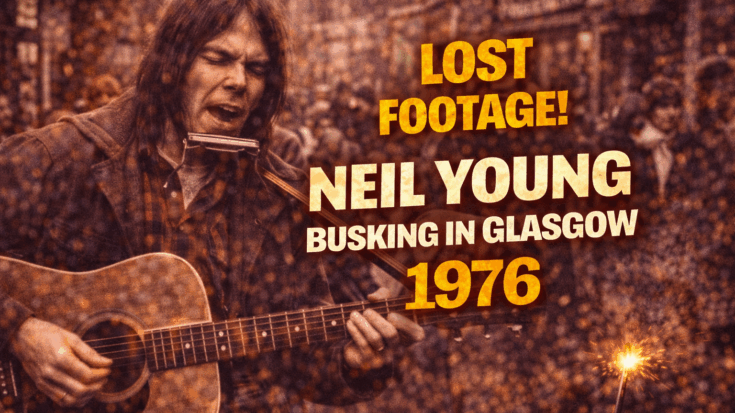
Neil Young has long projected an image that feels worlds away from rock-star excess. Even while spending most of his life elevated above crowds on concert stages, Young has consistently gravitated toward the ground level, where music meets everyday life.
In April 1976, that instinct led him into the streets of Glasgow.
A Rock Star Steps Off the Stage
Young arrived in Scotland with Crazy Horse for a headline show at The Apollo. Instead of disappearing into a hotel suite, he wandered into the city to meet people face to face, guitar slung over his shoulder. His appearance—uncombed hair, worn clothes, relaxed demeanor—matched his intentions. He looked less like a global rock figure and more like a roaming folk musician.
A local film crew had been hired to document the visit, led by director Murray Grigor and cinematographer David Peat. As Peat later recalled, their lack of rock-world savvy immediately set the tone. “The irony,” he told Open Culture, “is that neither Murray or myself were particularly knowledgeable about the rock world, and we knew little of this guy Neil Young. So we turned up at the airport in sports jackets and ties to meet him.”
Young, delayed after missing flights from London, finally arrived and quickly made his expectations clear. “Just give me some funky shit footage,” he reportedly told the filmmakers, signaling that the project would not be a polished promotional piece.
Chaos, Candor, and a City’s Grit
The shoot began unevenly. During a lunch stop at the Albany Hotel’s penthouse, one of the band members set fire to paper table decorations. Grigor remembered filming the scene as flames crept upward. “‘Just like Nam,’ another one said as he warmed his hands over the small inferno lapping up towards the inflammable ceiling.”
The atmosphere was loose, unruly, and far from controlled. “Neil and the band were all stoned out of their skulls,” Grigor said, underscoring the anything-goes mood of the visit.
Yet beneath the chaos was a clear sense of purpose. Young wanted to experience the city firsthand, drawn in part by his admiration for Scottish folk guitarist Bert Jansch. He wanted to feel the environment that shaped the music he loved, rather than observe it from a distance.
Back to Folk Roots at Central Station
Once the dust settled, Young headed into public spaces, casually asking passersby, “Excuse me, could you tell me where the Bank of Scotland is?” before settling near Glasgow’s Central Station. The plan, according to Grigor, was entirely Young’s. “To flop down at the entrance to Glasgow’s Central Station and then wait and see who would recognise him.”
At the time, Young was helping shape the heavier sound that would later be labeled grunge. Yet on that street corner, he returned to folk tradition—playing directly to strangers without amplification or spectacle. Whether the audience recognized him or was simply drawn to the music remains unclear.
What is undeniable is the intimacy of the moment. Armed with nothing more than a guitar, Young performed “The Old Laughing Lady” for unsuspecting Glaswegians. One woman’s uncontrollable laughter became an unforgettable part of the scene, capturing the essence of a rare encounter: a major artist choosing connection over celebrity, and music over myth.