




The Time Billy Joel Made a Bob Dylan Song His Own
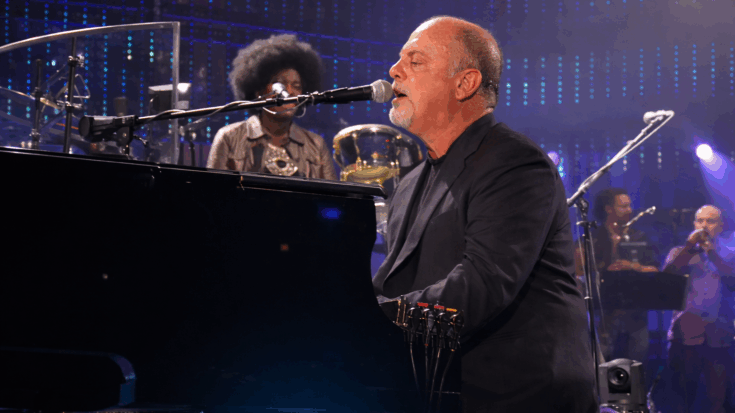
via "Front Row Music" / Youtube
Bob Dylan remains one of the most covered artists in modern music history, a distinction that speaks as much to accessibility as it does to artistry. His songwriting has rarely relied on intricate musical structures. Instead, Dylan favors straightforward chord progressions and familiar rhythms—an approach that allows aspiring musicians to pick up songs like “Like a Rolling Stone” with relative ease.
Yet, this simplicity is precisely what amplifies his impact. While the musical framework may be conventional, the lyrical content is anything but. Dylan’s words continue to resonate across generations, inviting interpretation, debate, and admiration decades after their release. His ability to merge plainspoken musicality with layered, poetic storytelling ultimately earned him the Nobel Prize in Literature, cementing his reputation as one of the most influential lyricists of all time.
A Songwriter’s Songwriter
Dylan’s influence stretches far beyond his own recordings, subtly shaping the work of countless artists who followed. Elements of his phrasing, imagery, and rhythmic sensibility can be heard woven into the fabric of contemporary songwriting. Among those most vocal about his impact is Bruce Springsteen, who has frequently credited Dylan as a formative influence.
“I was very influenced by Dylan,” Springsteen said.
Expanding on that sentiment, he added:
“I always say he’s the father of my country. He initially provided me with a picture of a country that I recognised. One that feels real, feels like the truth.”
Such praise underscores Dylan’s unique ability to articulate a shared cultural experience—one that resonates deeply with both listeners and fellow musicians.
Reinvention Through Covers
The duality of Dylan’s work—musically simple yet lyrically complex—has made his songs particularly attractive to reinterpretation. Artists across genres have sought to reshape his material, experimenting with new arrangements, instrumentation, and vocal delivery. While not every cover succeeds, some have achieved remarkable results.
Springsteen’s rendition of “Knockin’ on Heaven’s Door” stands out as one that earned Dylan’s own admiration. Reflecting on the performance, Dylan noted how it reconnected him with the song in unexpected ways:
“He did that song like the record, something I myself have never tried. I never even thought it was worth it. Maybe never had the manpower in one band to pull it off. I don’t know, but I never thought about it. To tell you the truth, I’d forgotten how the song ought to go… I’m not a nostalgic person, but for a second there it all came back, Peckinpah, Slim Pickens, Katy Jurado, James Coburn, the dusty lawless streets of Durango, my first wife, my kids when they were small. For a second it all came back… it was that powerful.”
Billy Joel offers another compelling example. On Greatest Hits: Volume III, he included a version of “Make You Feel My Love,” subtly reshaping the song to highlight different emotional textures. Dylan praised Joel’s interpretation, acknowledging the perspective that a fellow songwriter can bring:
“Billy Joel’s a very dynamic artist, and he can hear things in a song because he’s also a songwriter,” Dylan said, concluding:
“He managed to probably convey that song in a different way than me. Nevertheless, he got something out of that song that I would have never dreamed of myself. That’s what happens when you write a song. Somebody can definitely interpret it a different way than the person who wrote it.”
In the end, Dylan’s catalog continues to thrive not only because of its original brilliance, but because of its adaptability—songs that invite reinvention while retaining their core emotional truth.