




Steve Brown Responds After Ace Frehley Ally Accuses Him of Betrayal
Steve Brown Responds After Ace Frehley Ally Accuses Him of Betrayal
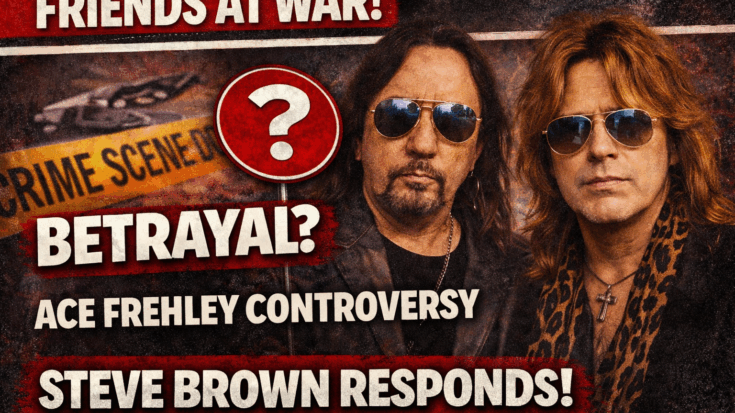
Steve Brown has publicly responded to allegations that his relationship with Ace Frehley was strained prior to the guitarist’s death. The claims surfaced after remarks from Frehley’s longtime friend and mentor Peppy Castro, who suggested Frehley was upset with Brown and had distanced himself from him in his final months.
Speaking on the Denim and Leather Rock and Metal Podcast, Brown offered a detailed account of their collaboration, describing it as both creatively productive and personally meaningful. His remarks were intended, he said, to clarify what he believes was a mischaracterization of their working relationship.
Inside the Creative Partnership
According to Brown, the collaboration began when he sent Frehley several fully formed song ideas, including early versions of “Walking on the Moon,” “Fighting for Life,” and “Cherry Medicine.” Brown emphasized that these demos were already close to their final arrangements.
“I sent Ace a couple of ideas… they were kind of finished things,” Brown said. “Walking on the Moon already had a lot of what ended up on the record.”
Months later, Brown received an unexpected phone call that he described as a turning point.
“I’m getting out of the shower, I’m dripping wet, and my phone rings,” he recalled. “I look down and it says Paul Frehley… and I’m like, holy shit, he’s finally calling.”
Brown said Frehley was immediately enthusiastic, praising the material and energetically reworking one song in real time.
“He goes, ‘This stuff’s great,’ and then he starts talking about changing the title… ‘It’s called Walking on the Moon. That’s going to be the title of the record,” Brown said. “He’s talking for five minutes straight, and I’m just sitting there thinking, this is awesome.”
Within days, Brown traveled to Frehley’s New Jersey home, where the pair completed the lyrics, melodies, and most of the vocals for the track during their first session.
“We did about 90 percent of the vocals that first day,” Brown said.
He also described Frehley’s relentless creative drive. After that initial session, Frehley reportedly returned to the studio late at night, unable to sleep, and independently wrote and recorded the song’s bridge.
“He was so excited, he couldn’t sleep,” Brown said. “He went down and recorded it himself.”
Conflicting Narratives and a Complicated Legacy
Brown said the relationship extended beyond the studio, describing a close personal bond that included Frehley gifting him guitars used during the recording sessions.
“He gave me his Les Paul,” Brown said. “He told me, ‘I want you to have this because I know we’re going to be making a lot more music together.’”
That future, however, never materialized. Brown revealed that Frehley had planned to complete Origins Vol. 3 with longtime collaborator Alex Saltzman before resuming work with Brown on a follow-up to 10,000 Volts.
Castro’s account sharply contradicts Brown’s version of events. Castro claimed Frehley was angered by comments Brown had made, returned to working with Saltzman as a result, and that Brown was “cold-shouldered” at Frehley’s wake and not invited to the funeral.
“Ace was pissed,” Castro said. “Why do you think he went back to Alex?”
The disagreement has sparked broader discussion within the rock community, particularly given Frehley’s outsized influence and often turbulent personal history. The Eddie Trunk Podcast reported that Frehley died at 74 following injuries, prompting an outpouring of tributes from fellow musicians and industry figures.
Throughout his career, Frehley experienced extraordinary success alongside well-documented struggles. According to KISS NEWS USA, many peers continued to support him despite his reputation for unpredictability, underscoring the deep respect he commanded as a guitarist and songwriter with KISS.
Frehley had also expressed regret over missed opportunities, including never collaborating on a post-KISS project with former bandmate Peter Criss—a reminder that creative ambition continued to shape his outlook late in life.
In the end, the dispute between Brown’s recollections and Castro’s claims reflects the broader complexity that surrounded Frehley himself. Like many rock icons, his legacy is shaped not only by the music he made, but by the conflicting memories of those closest to him. What remains uncontested is his lasting impact—and the sense that, even in his final chapter, Ace Frehley was still chasing the next song.