




The Reason Chris Poland Stayed Away From Megadeth
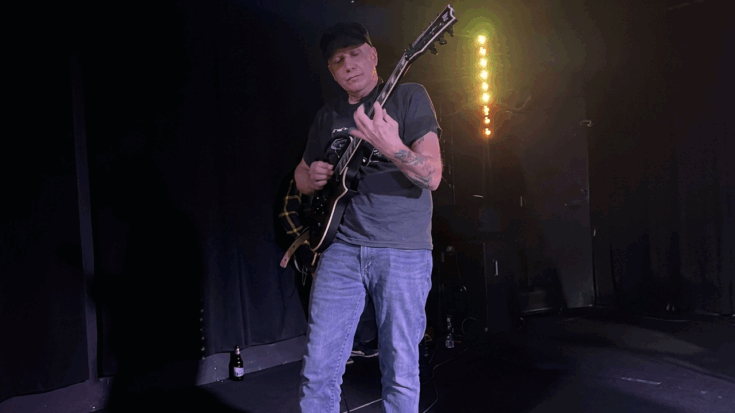
via "leonshreds" / Youtube
Former Megadeth guitarist Chris Poland has revisited a pivotal moment in his career—his decision to turn down an offer to rejoin the band years after his 1987 exit. Speaking in a recent interview with VRP Rocks, Poland offered a candid account shaped by hard-earned perspective, personal struggle, and a clear-eyed understanding of the environment he once left behind.
A Warning That Changed the Course
Poland recalled the drive to meet Dave Mustaine and management, a moment that could have rewritten his history with the band. Instead, it became a turning point in a different sense—one defined by restraint.
“I was driving there to meet Ron Lafitte and Dave [Mustaine], and I think Andy Somers was there too,” Poland said. “And I was driving there with Janie Hoffman, my manager, and she’s driving. And she’s going, ‘Chris, are you seriously going to join this band?’ And I said, ‘I’m thinking about it.’ And she’s like, ‘If you join the band, you’ll be dead in a year.’”
The starkness of that warning lingered. In the context of the band’s volatile lifestyle at the time, it was less hyperbole and more a reflection of lived reality. For Poland, it reframed the opportunity—not as a triumphant return, but as a potential risk to his survival.
The Weight of the Past
As Poland considered the offer, memories of his earlier tenure resurfaced, particularly his struggles with addiction. A comment from bassist Dave Ellefson echoed in his mind:
“We had quite a long drive to get there, and I was thinking about it,” he continued. “And y’know, Dave Ellefson said something to me one time about drugs. He goes, ‘You hang around a barbershop long enough, you’re going to get a haircut.’”
The metaphor proved prophetic. Poland described how, during the band’s early touring years, he had managed to get clean while they were away—only to relapse soon after re-entering the same environment.
“So you know what? The same thing happened when they went on tour, the first tour [for ‘Killing Is My Business’], when I didn’t go,” Poland explained. “While they were gone, I got off heroin. It was terrible, but I did it. When they came back, I was clean, and I’m hanging out with them, and they’re doing it, and I’m not. And so, of course, my wheels are turning, and boom, not even a month later…all for nothing.”
These experiences underscored a difficult truth: the issue was not just personal discipline, but proximity. Returning to the band risked reopening the same cycle he had fought to escape.
Letting Go—and Looking Forward
Another factor helped solidify his decision. The possibility of Marty Friedman stepping in as lead guitarist gave Poland confidence that the band would be in capable hands.
“On my drive to meet those guys to say whether I would join or not, as soon as they said Marty Friedman was an option, I knew I could say I didn’t want to do it,” he said. “Because I knew Marty could do that gig standing on his head. They were mad. I couldn’t believe how mad they were, man!”
Poland’s departure from Megadeth in 1987 had already been marked by tension—stemming from financial disputes, lateness, and internal friction—but his contributions to the band’s early sound remained undeniable. From Killing Is My Business… and Business Is Good! to Peace Sells… but Who’s Buying?, his distinctive phrasing—shaped in part by a hand injury—left a lasting imprint on thrash metal’s formative years.
Friedman’s eventual arrival on Rust in Peace would usher in a new era of technical precision and commercial success for Megadeth, validating Poland’s confidence in his successor. Yet Poland’s story does not read as one of missed opportunity. Instead, it reflects a rare instance of an artist choosing distance over legacy, stability over spotlight.
In hindsight, Poland has acknowledged that he never anticipated the band’s longevity or global impact. But that unpredictability is part of what makes his decision resonate more deeply. Rather than chasing what Megadeth would become, he chose to step away from what it had been for him.
Today, his outlook suggests neither regret nor bitterness, but a measured openness. A reunion is not framed as redemption or unfinished business—it is simply a possibility, contingent on circumstances that prioritize well-being over nostalgia. In an industry often defined by second chances and revived lineups, Poland’s restraint stands out as a reminder that sometimes the most defining move is the one not taken.