




Phil Collins Admits He Never Liked One of His Own Songs
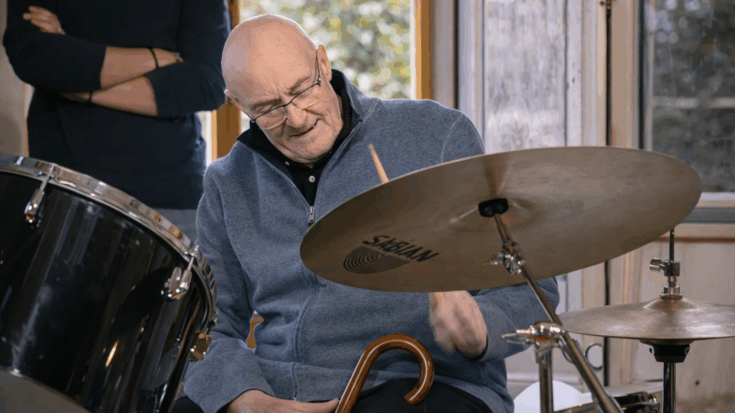
via "DrumeoOfficial" / Youtube
For all the chart success associated with Phil Collins, his prowess behind the drum kit is often underappreciated. Within Genesis, there was never any compromise when it came to musicianship, and Collins’ skill set quickly set him apart. His reputation was strong enough to earn admiration from Neil Peart, placing him among the most respected drummers of his generation.
Yet, despite his technical ability and musical instincts, Collins did not always view his recorded performances in the same light. There were moments where he felt his bandmates walked away with stronger takes, while his own contributions fell short of his expectations.
Creative Tensions in Genesis’ Formative Years
Collins’ role in Genesis extended well beyond percussion. As the band evolved from their early days, he became a crucial figure in arranging and shaping their compositions. The group, still developing its identity after forming in school, often struggled to align their ideas—particularly once Peter Gabriel began layering his distinctive lyrics over their increasingly complex musical structures.
While Collins frequently acted as a stabilizing force, helping transform loose ideas into cohesive tracks, that role sometimes came at a cost. His focus on structure and cohesion occasionally limited his ability to fully showcase his own musicianship behind the drums.
“I Was Stuck With That Take”: Frustration and Imperfection on Record
That tension is especially evident on Nursery Cryme, a record that hinted at the band’s future creative heights, later realized on Selling England by the Pound. Among its standout tracks, “The Fountain of Salmacis” remains a defining moment—though not one Collins remembers fondly.
Despite the song’s power and cohesion, Collins expressed dissatisfaction with his own performance, feeling constrained during the recording process. At the time, the band’s approach centered on capturing a complete take before layering overdubs, a method that often required numerous attempts.
Reflecting on the experience, Collins explained:
“The idea would be to get a take where we all played well. By the time we get to 32 takes, no one’s playing well, and we’re all looking at each other so no one makes a mistake. So we get that far, I’m well past my best, and they all replace their parts. Of course, I was stuck with that take. I always resented that. Now you have computers and you can do whatever you want.”
While Collins viewed the take as flawed, it ultimately contributed to the track’s intensity. The accumulated fatigue and pressure created a palpable tension that translated into a compelling performance—something modern recording precision often struggles to replicate.
Even as digital tools like Pro Tools have made it easier to perfect performances, they cannot fully recreate the human element that defined Collins’ playing. His timing, feel, and subtle imperfections became part of his signature, particularly on later works such as The Lamb Lies Down on Broadway.
In retrospect, the very qualities Collins once questioned have come to define his legacy. His performances may not have always been technically flawless, but they carried an emotional weight that continues to resonate—proving that, in music, imperfection can often be the key to authenticity.