




Nuno Bettencourt Invites Fans to Guitar Masterclass
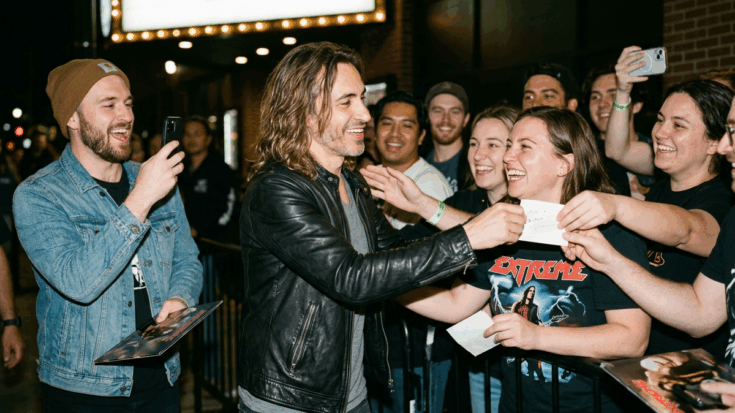
Set against the dramatic desert landscape of the Mojave Mountains, the Hilton Lake Las Vegas Resort and Spa is usually a quiet retreat where visitors escape the rush of everyday life. In January 2026, however, the tranquil resort will take on a very different energy. From January 16 to January 20, the lakeside venue will host Nuno Bettencourt’s Six String Sanctuary, a four-day immersive experience built around creativity, conversation, and the shared culture of guitar playing.
For Bettencourt, the acclaimed guitarist of Extreme, the event marks his first attempt to create a personally curated guitar camp. Rather than designing a typical instructional retreat focused on scales and technical drills, Bettencourt has assembled a lineup of mentors to inspire players more deeply. The guest roster includes celebrated musicians such as Steve Vai, Eric Gales, Richie Kotzen, Rick Beato, Mateus Asato, and Taj Farrant.
Backing them is a formidable house band featuring Marco Minnemann, Derek Sherinian, and Vincen García, while late-night jam sessions will include appearances by Doug Doppler, Larry Mitchell, Luís Kalil, Teresa Topaz, and Dave Weiner. Between workshops, performances, and informal gatherings, the camp is structured to give participants both guidance and a sense of community.
Despite his reputation as one of modern rock’s most admired guitarists, Bettencourt admits that stepping into a mentorship role feels intimidating.
“This is like Kryptonite for me,” Bettencourt says with a laugh. “I can play in front of 70,000 people, but doing this Six String Sanctuary is a bit like going into a warzone. It’s something I haven’t done much because I don’t see myself as the kind of teacher who does these master clinic things. I’m more about the philosophy of everything than the technicalities.”
A Camp Built on Passion, Not Technique
Ironically, Bettencourt’s own reluctance to teach eventually convinced him he had something meaningful to offer. His perspective changed after taking part in similar clinics hosted by Steve Vai and Tom Morello.
“I did Steve Vai’s event because he personally asked me,” Bettencourt explains. “I did another with Tom Morello as well. What I found out was that there are different ways to approach it. You don’t have to talk about the technique or theory.”
Instead of focusing on instruction that can easily be found online, Bettencourt believes the real value lies in sharing the experiences behind the music.
“People can get that anywhere, they can punch it up online whenever they want. There are videos that will show you how to play my solos better than I ever could, probably because I don’t even remember how to play the fuckin’ things. My Six String Sanctuary will be more about the mythology of it all – from the experience and the passion to the hustle.”
At the heart of the event is a simple philosophical question Bettencourt plans to ask participants: Why do you play guitar?
For him, the answer to that question matters far more than technical ability. Some players are driven by joy, others by ambition, and many by the desire to follow in the footsteps of their musical heroes. The sanctuary, Bettencourt says, is meant to be a pressure-free environment where those motivations can be explored openly.
Players of any level are welcome. Whether someone picked up a guitar the night before or has spent decades mastering the instrument, the goal is to create a space where musicians can exchange ideas, learn from each other, and rediscover their passion.
Gathering a Brotherhood of Guitarists
The lineup Bettencourt assembled reflects that philosophy. Rather than selecting players based purely on technical prowess, he chose musicians who bring a unique artistic voice to the instrument.
“We’re all part of a culture – we’re almost an ethnicity when it comes to guitar,” Bettencourt says. “I can relate to them and they all touch me as players, composers, arrangers, lyricists and singers. I wanted to bring all the tools to the table. They’re all like-minded players. They all have a superpower that they can offer.”
Among the most exciting additions is modern blues powerhouse Eric Gales, whom Bettencourt considers one of the most compelling players in the genre today.
“When it comes to proper blues, it’s super hard to stand out,” Bettencourt says. “Blues can be very strict in what it allows. It’s a bit like players get told, ‘Here’s the box and good luck not repeating what everyone else has done!’”
He argues that the apparent simplicity of blues actually makes originality harder to achieve.
“Someone like Eric has to play something that’s strong enough to say ‘Hey, I’m over here!’ Sure, the classic blues licks are what a lot of people start out playing. It’s simple and basic, so how do you make it complex? How do you create your own simplexity?”
Another unconventional inclusion is music educator and producer Rick Beato, whose analytical approach to songwriting and production has earned him a massive following.
“He was a hard one,” Bettencourt admits. “Luckily, I got to know him as a friend after he interviewed me. I told him how much he intimidated me because he knows too much about what I’m doing. It’s like he can see the Matrix while the rest of us are hoping for the best.”
Still, Bettencourt believes Beato’s insight will add a valuable dimension to the camp.
“He’s like the Yoda of it all. He’s a great player, writer, producer and one of the most respected in his field. He can sit down with David Gilmour or take apart an Eagles or Steely Dan song in a respectful way. He also has the courage to say when things don’t sound so good.”
Richie Kotzen brings yet another perspective, combining virtuosic guitar work with soulful vocals and songwriting.
“If I was starting out as a guitar player and that voice came out of me, I never would have picked up a guitar,” Bettencourt says. “I’d be fronting a legendary rock band playing stadiums! Richie’s voice is so soulful and his guitar playing is ridiculous.”
Kotzen’s fingerstyle technique — performed entirely without a pick — is something Bettencourt himself admires.
“He’s a great writer, and then you have to remember he plays without a pick… doing all that stuff with just his fingers, which I could never do.”
Passing the Torch to the Next Generation
The sanctuary will also highlight younger talent, including Australian guitarist Taj Farrant, whom Bettencourt sees as a rising star.
“I’m excited about Taj because he’s going to bear the torch for a lot of people,” he says. “He’s got it all – passion, writing, playing, performing – all of it.”
For Bettencourt, discussions about talent often miss the real story behind great musicianship: dedication.
“You can play for five years but only two hours a day, or for one year 16 hours a day,” he says. “You just have to do it. It all comes from the 10,000 hours. There’s nothing worse than someone saying, ‘You were born with a gift.’ No, go fuck yourself, I got up every day and picked up that guitar when I was supposed to be doing other things.”
Brazilian guitarist Mateus Asato is another mentor Bettencourt believes will inspire attendees, particularly because of his melodic sensibility.
“What blew me away most about his Instagram posts was his compositional skills and chord structures,” Bettencourt says. “There’s a beauty in his melody and playing. That, to me, is his superpower.”
At the same time, Bettencourt warns that Asato’s calm musicality hides a fierce player underneath.
“He has this masterful control of harmonic beauty, but if you say ‘fuck you’ to him, he will say ‘fuck you’ back in a big way. You don’t want to get him angry because he will tear you up.”
More Than a Guitar Camp
Unlike traditional music workshops, the Six String Sanctuary is designed as a fully immersive experience. Participants will share meals, jam sessions, and casual conversations with the mentors, blurring the line between student and performer.
“This camp is giving people access to genuine guitar masters,” Bettencourt says. “And it’s not just guitar lessons, you’ll be living with these guys. You’ll eat with them, see them in the hall and share a building with them for four days.”
That environment, Bettencourt believes, creates the potential for unexpected inspiration. He recalls one moment after a Generation Axe show when a devoted Yngwie Malmsteen fan approached him holding a scalloped-fret Stratocaster.
“He looked almost angry, saying, ‘You know, I came to see Yngwie…’ And I said ‘Okay’, thinking he was about to knock me out! And then he told me that he walked away from my performance as a new fan and that he loved what I played and said.”
Experiences like that reinforce Bettencourt’s belief that the most powerful musical discoveries often happen when expectations are set aside.
“You’ll come to see your favorite player,” he says, “but you’ll hear all these other musicians who might blow your mind just as much, or even more.”
Ultimately, Bettencourt hopes the Six String Sanctuary will remind players that music is not about competition or comparison. Every guitarist, no matter their level, brings a unique voice to the instrument.
“We are equal, doing it for the love of our instruments,” Bettencourt says. “I’m no more special than anyone else. The real truth is that, as great as all of us mentors are, none of us could ever sound like you.”
For Bettencourt, that individuality is what keeps the guitar alive generation after generation. Technical brilliance may inspire admiration, but authenticity is what truly resonates. In the end, he believes the most important lesson musicians can take home from the sanctuary is not a new lick or scale, but the confidence to embrace their own musical identity and let it be heard.