




How Bonnie Raitt Talked Melissa Etheridge Out of Her Les Paul
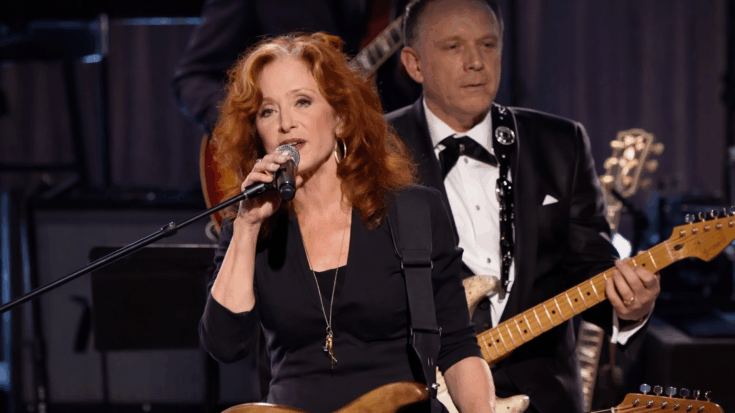
via Tracy Chapman Online / Youtube
Melissa Etheridge’s guitar style was never built in isolation—it was shaped by a deep admiration for players who brought both intensity and soul to the instrument. Speaking in a recent interview with Guitar Player, Etheridge pointed to three defining influences who helped form her musical identity early on.
“When I was playing acoustic, I was very influenced by Richie Havens and José Feliciano,” she said. “They both had this powerful way of playing an acoustic guitar, so I really followed that. And then Keith Richards; when I heard the Rolling Stones stuff, I felt like, ‘I can do that!’ Those three – to me, that’s guitar playing.”
That blend of rhythmic force and raw accessibility became a cornerstone of Etheridge’s approach. Havens and Feliciano offered a percussive, almost physical relationship with the acoustic guitar, while Richards provided the swagger and simplicity of rock ’n’ roll. Together, they gave Etheridge both a blueprint and the confidence to carve out her own voice—one rooted in feel rather than flash.
Bonnie Raitt’s Guidance and a Crucial Trade-Off
As Etheridge transitioned into the professional world, she found herself navigating unfamiliar territory—particularly with the electric guitar. Though she had secured a deal with Island Records, she was still developing the practical skills needed for life on the road. Enter Bonnie Raitt, a veteran player whose mentorship would prove invaluable.
Etheridge had been using a 1978 Gibson Les Paul Custom, purchased back in Kansas with her father. While iconic in tone and stature, the instrument posed a serious problem: its weight. Built during the Norlin era, the guitar was notoriously heavy—something Etheridge felt acutely during performances.
“She took me under her wing,” Etheridge recalled. “She told me, ‘That Les Paul’s too heavy for you, honey. You’re not gonna be able to do that.’ So she took me to Norm’s Rare Guitars when it was deep in the Valley.”
Raitt’s advice was both practical and transformative. At Norman Harris’ famed shop, Etheridge made a defining decision—trading in her Les Paul for a Fender Stratocaster. The Strat offered comfort, versatility, and a clearer path forward as a touring musician, even if the emotional weight of the trade lingered.
Chasing the Past While Moving Forward
Looking back, Etheridge admits there’s a hint of regret attached to that decision—less for the sound she left behind, and more for the history she let go.
“I traded in my Les Paul for a Strat… although I wish I still had that Les Paul, ’cause it’d be worth a lot of money now,” she said.
Her attempts to track down the instrument have so far come up empty. Like many stories involving vintage gear, the trail has gone cold, with no records to follow and no clear owner to trace.
“If I knew where it was I’d go find it,” she added. “I’ve even asked Norm, but he doesn’t have any records of the things he sold from that long ago. But just recently somebody gifted me a 1979 Les Paul, so that makes up for a little bit.”
Yet Etheridge’s story isn’t one of longing—it’s one of evolution. Now decades into her career, she continues to create with the same urgency and authenticity that first defined her playing. Her upcoming 17th studio album, Rise, recorded at Los Angeles’ Sunset Sound and co-produced with Shooter Jennings, reflects an artist still pushing forward rather than looking back.
In many ways, the missing Les Paul has become more than just a lost guitar—it’s a symbol of the choices that shape a musician’s path. Etheridge didn’t just trade instruments; she traded comfort for endurance, nostalgia for growth. And in doing so, she built a career defined not by what she left behind, but by the sound she continues to chase.