




4 Legendary Frontmen Like Steve Perry Who Quietly Passed on a Farewell Tour
Fans of rock music enjoy a good comeback tale. The idea of a famous band getting back together for one last big tour is always intriguing. A farewell tour often feels like a victory lap. It’s a party, a reunion, and frequently a major payday all at once. Stadiums fill up, classic songs echo through the speakers, and fans get one more chance to relive their youth. But not every lead singer wants that kind of ending.
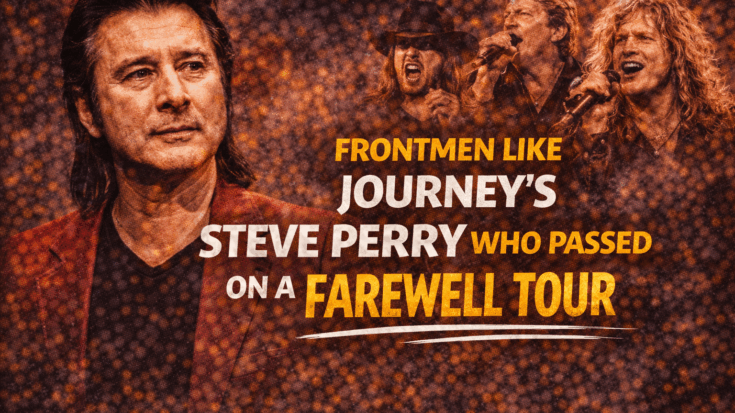
In early 2026, speculation began about the possibility of Steve Perry returning to Journey for the band’s final tour. Journey was preparing to bring its illustrious career to a close with a final run of shows after more than 50 years in the business. Fans couldn’t help but hope that Perry, who sang on many of the band’s biggest hits, would step back onstage with his former bandmates. For a moment, it seemed possible. In an interview, Journey keyboardist Jonathan Cain suggested that the door wasn’t completely closed. With nearly 100 shows planned, the potential for a surprise appearance existed. Fans went wild at the idea of Perry returning, even if only for a night or two.
Perry ultimately addressed the situation himself. In a message shared online, he thanked fans for their continued support but confirmed that he would not be rejoining the band. He explained that he doesn’t want to dwell on the past and instead prefers to focus on creating new music that reflects who he is now. While some fans were disappointed, Perry is far from alone. Over the years, many famous frontmen have declined opportunities to reunite with their former bands for what could have been historic farewell tours. Some wanted to protect a band’s legacy. Others valued creative freedom. In certain cases, unresolved tensions simply never disappeared.
Here are four more rock singers who chose not to cash in on a final reunion.
Robert Plant (Led Zeppelin)
Rumors about Led Zeppelin reuniting have circulated for decades, but few have endured as long. Fans have spent years hoping the remaining members would embark on a full tour. Robert Plant has consistently declined. Led Zeppelin was one of the most influential rock bands of the 1970s, achieving worldwide fame through its blend of blues, hard rock, and epic songwriting. In 1980, however, the band’s story took a tragic turn when drummer John Bonham died after years of heavy drinking, shocking the music world.
Soon afterward, the remaining members announced they would no longer continue as Led Zeppelin. They believed Bonham was too essential to the band’s sound and chemistry to be replaced. Rather than bring in a new drummer, they chose to disband. There have only been a handful of occasions when Plant, Jimmy Page, and John Paul Jones performed together again. The most notable was a one-off concert in London in 2007, which drew enormous demand, with millions of fans attempting to secure tickets. It proved that interest in a reunion had never truly faded.
Despite this, Plant has always refused to turn that performance into a full tour. He has repeatedly stated that the band wouldn’t feel right without Bonham, emphasizing that some bonds can’t be restored once a crucial piece is gone. Instead of revisiting Led Zeppelin’s catalog night after night, Plant has pursued a solo career and collaborated with artists such as Alison Krauss, exploring folk, country, and Americana sounds far removed from “Stairway to Heaven.” While reunion tours are lucrative, Plant appears content leaving Led Zeppelin’s legacy untouched. He believes the band’s story reached a natural conclusion and prefers to keep it that way.
Mark Knopfler (Dire Straits)
Dire Straits was among the most successful bands of the late 1970s and early 1980s, earning a place in rock history with smooth guitar work and thoughtful lyrics. Songs like “Sultans of Swing” helped launch their career, and later hits only expanded their popularity. Mark Knopfler was at the center of it all, known for his relaxed stage presence and instantly recognizable guitar tone. When Dire Straits stopped touring in the early 1990s, many fans assumed it was only a temporary break. That hiatus, however, became permanent.
Knopfler went on to build a successful solo career, releasing albums rooted in folk, roots rock, and film soundtracks. As the years passed, fans continued to ask whether Dire Straits might reunite. His response has remained unchanged: he has no real interest in returning.
In interviews, Knopfler has explained that while he enjoyed being in the band, he values his independence even more. He collaborates with a wide range of artists and records in his own studio, designed specifically to suit his creative process. He has said he enjoys composing music on his own terms. Dire Straits has sold more than 100 million records worldwide, making a reunion tour potentially extremely profitable. Still, financial incentives do not appear to motivate Knopfler. He seems happiest working on projects that inspire him now rather than revisiting past triumphs.
Roger Waters (Pink Floyd)
Pink Floyd’s music defined an era. Albums such as The Dark Side of the Moon and The Wall became cultural landmarks. Roger Waters was the band’s primary songwriter throughout the 1970s, shaping much of its artistic direction. By the mid-1980s, however, internal conflicts had escalated to the point of no return. Waters left Pink Floyd in 1985, believing the band had run its course. When David Gilmour and Nick Mason continued under the Pink Floyd name, it sparked a bitter dispute, followed by legal battles that further damaged relationships.
There have been brief moments of reconciliation over the years. In 2005, the classic lineup reunited for the Live 8 charity concert, giving fans a rare glimpse of their former chemistry. Later, during one of Waters’ solo performances of The Wall, Gilmour and Mason joined him onstage. These appearances, however, were exceptions rather than signs of a lasting reunion.
Waters has made it clear that he has no desire for a full Pink Floyd reunion. While he remains proud of the work they created together, he seems content to leave that chapter behind. Instead, he focuses on his own tours, which often feature elaborate productions centered on Pink Floyd material, interpreted through his personal vision. Returning to the band as a full-time member holds little appeal for him. The artistic and personal differences that once divided them appear to have left a lasting mark.
Peter Gabriel (Genesis)
Fans of Genesis wondered whether Peter Gabriel might appear onstage when the band played its final show in 2022. Gabriel was a central figure in the band’s early identity during the 1970s, when Genesis was known for theatrical performances and imaginative storytelling.
Gabriel did attend the final concert, but he watched from the audience rather than joining the band. He left Genesis in 1975 to pursue a solo career that proved highly successful. Over time, his music evolved toward pop and world music influences. Meanwhile, drummer Phil Collins stepped in as lead singer and guided Genesis to even greater commercial heights. Since Gabriel’s departure, there have been a few limited collaborations. In 1999, he and Collins reunited to record a new version of “Carpet Crawlers.” Still, Gabriel has largely avoided full-scale reunion tours.
He did not attend Genesis’ induction into the Rock and Roll Hall of Fame, citing other commitments. Gabriel has become increasingly selective about public appearances and the amount of music he releases. He has suggested that long absences can help sustain interest rather than oversaturate audiences. While he chose not to perform at Genesis’ final show, his presence in the crowd signaled respect for the band’s journey. He wanted to witness the closing chapter—just not from behind a microphone.
Choosing the Present Over the Past
It’s easy for fans to imagine reunion tours as joyful celebrations filled with nostalgia, excitement, and closure. For artists, however, the decision is often far more complex. Some want to preserve a band’s legacy. Others feel that essential members are irreplaceable. Creative freedom, personal growth, and unresolved conflicts all play a role.
Steve Perry’s choice to focus on new music aligns with a path taken by many frontmen before him: choosing not to look back. Robert Plant protects Led Zeppelin’s legacy, Mark Knopfler embraces independence, Roger Waters keeps his distance from Pink Floyd, and Peter Gabriel maintains separation from Genesis. Each made a decision that felt right for him. While farewell tours can offer one last grand spectacle, for some rock legends, the real victory lies in moving forward on their own terms.