




The Day Punk Rock Lost Joey Ramone
via "Musikladen" / Youtube
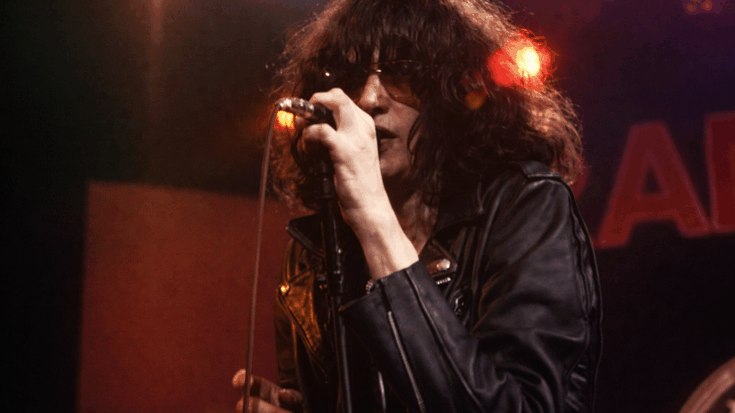
Though he stood at the center of one of punk rock’s most influential bands, Joey Ramone was never the archetypal frontman. As the voice of the Ramones, he projected a singular presence onstage, but off it, he remained reserved—often shy, occasionally awkward, and slow to emerge from his shell. Those who knew him best understood that this quiet demeanor was not an affectation but something shaped by years of physical and psychological struggle.
A Life Marked by Early Health Challenges
Born Jeffrey Ross Hyman, Ramone’s difficulties began early. A spinal tumor discovered in childhood was successfully removed, but it marked the start of persistent health issues that followed him into adulthood. According to his younger brother, Mickey Leigh, these complications extended beyond the visible.
“He was prone to infections because his neurological system was not right,” Leigh told Classic Rock in 2016. “If he stepped on something and cut his foot, he would wind up in hospital on intravenous antibiotics. He was always going to the doctors.”
At 18, Ramone suffered a psychotic episode and was later diagnosed with obsessive-compulsive disorder, a condition that profoundly affected his daily life. “It was something that was always there and he always had to struggle with,” Leigh continued. “These voices in his head would say, ‘You didn’t close this door right, you gotta do it again.’ He would do it 20 times until it was right.” The compulsions and intrusive thoughts, Leigh noted, set him apart:
“Because of what was going on in his head, he was different.”
The Final Years and a Private Battle
In 1995, Ramone received a diagnosis of lymphatic cancer—news he chose to keep largely private. The following year, in February 1996, he and Marky Ramone appeared on Howard Stern’s show to confirm that the Ramones would be disbanding. When asked about his plans, Ramone deflected with characteristic wit: “I’m gonna get a bed at the Howard Stern retirement home.”
Six months later, the band played its final show in Los Angeles, closing the curtain on a career that helped define American punk. Behind the scenes, however, Ramone’s health remained fragile and increasingly precarious—though largely shielded from public view.
In December 2000, a fall on a New York City street resulted in a broken hip and hospitalization. He was briefly discharged in February 2001 before being readmitted. By March, news of his cancer became public, accompanied by cautious optimism about his condition. Spokesman Arturo Vega told the New York Daily News that Ramone had recently been watching The Sopranos, adding:
“He’s doing better and better.”
The improvement would be short-lived.
A Lasting Goodbye and Musical Afterlife
On April 15, 2001—Easter Sunday—Joey Ramone died at New York-Presbyterian Hospital at the age of 49. Reports later suggested he was listening to In a Little While by U2 at the time of his death, a detail that has since taken on near-mythic resonance.
That same evening, during a concert in Oregon, U2 paid tribute with a performance of “I Remember You,” originally released on the Ramones’ 1977 album Leave Home. Frontman Bono later reflected on the moment in Rolling Stone:
“I told the people, ‘I want to talk to you about Joey Ramone…,’ and the whole crowd went up in this roar. The shock was the crowd sang it, the whole tune. Then I said that Joey had passed away that day. The roar stopped right there. The place went silent. It was a very powerful thing to be a part of.”
In his final months, Ramone had been working intently on his first solo album, determined to complete it despite his declining health. Producer Daniel Rey recalled his unwavering commitment:
“He was talking about getting out of bed so he could be in shape to go on tour. If he wasn’t feeling great, he didn’t go to the studio, because it didn’t feel rock & roll to him.”
Released in February 2002, Don’t Worry About Me arrived less than a year after his death and just ahead of the Ramones’ induction into the Rock & Roll Hall of Fame. Critics praised the album as a poignant and uplifting farewell. Rey observed a notable shift in Ramone’s performance, saying:
“His voice seemed a lot richer, more manly. It was like he was saying, ‘I’m comfortable with myself.’”
In retrospect, Ramone’s legacy extends beyond his contributions to punk rock. His story is one of perseverance—an artist who carried private burdens while shaping a sound that would echo across generations.