




Adam Sandler Recalls the Wild Aerosmith Fight at SNL
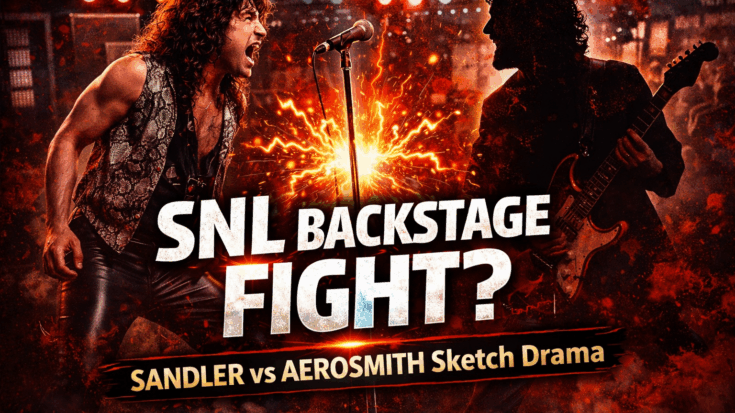
In January 1995, a Saturday Night Live sketch intended as satire nearly escalated into a backstage confrontation. The episode, part of Season 20 and hosted by Jeff Daniels, featured a fake commercial conceived by cast member Adam Sandler. The parody promoted a fictional album titled Aerosmith’s Greatest Hits: 1990–1994, poking fun at Aerosmith and their run of power ballads in the early ’90s.
The sketch took particular aim at “Crazy,” “Cryin’,” and “Amazing,” exaggerating the notion that the songs were virtually interchangeable, sharing similar melodies and structures with only slight lyrical variations. Sandler portrayed frontman Steven Tyler, while fellow cast member Jay Mohr was cast as guitarist Joe Perry.
Mohr later recounted in his memoir Gasping for Airtime that the musical critique at the heart of the joke was not entirely unfounded. “As Adam sang every song, it became clear that the guitar part never changed. The sad part was that it was true,” he wrote. After questioning the accuracy of the parody, Mohr consulted SNL bandleader G.E. Smith, who proved the point by seamlessly moving between multiple Aerosmith hits without altering his finger placement on the guitar.
“[Smith] swore he could play fifteen Aerosmith songs and never move a finger,” Mohr recalled. “I didn’t believe him until he launched into ‘Cryin’,’ then ‘Crazy,’ without changing the position of any of his fingers on the fret.”
Tensions Flare Moments Before Airtime
For Mohr, who had been struggling for exposure on the show, the opportunity to appear in a high-profile sketch alongside Sandler felt significant. However, moments before going live, excitement gave way to friction.
Waiting beneath the studio bleachers during a commercial break, Mohr—fully costumed in leather pants, wig, and guitar—noticed what he felt was a flaw in Sandler’s otherwise spot-on Steven Tyler look.
“I had shaved my chest to look more like Joe Perry,” Mohr wrote. “Sandler was dressed just like Steven Tyler… except that he was wearing a pair of sunglasses that looked like Elton John’s.”
Mohr suggested a last-minute change and then tried again as the seconds ticked down. Sandler, already under pressure, reacted sharply. “‘Why don’t you shut the f— up!’ Adam yelled,” Mohr recalled.
“I was stunned,” he added. “Looking back, I realize my timing was inappropriate… What the hell did I care what kind of sunglasses he had on? But I did care. For some reason I cared a lot.”
That reaction, Mohr later acknowledged, stemmed from deeper frustrations—namely, resentment over Sandler’s growing popularity and his own lack of airtime. What began as a trivial disagreement nearly turned physical before the presence of the live audience brought things to a halt.
After the Laughs, a Changing Era at SNL
Despite the confrontation, both performers delivered the sketch without incident. The audience responded positively, and within minutes the tension was swallowed by the pace of live television.
As they exited the stage, Sandler briefly addressed the situation. “‘We’re good,’ he said. ‘Respect,’” Mohr remembered. “He didn’t apologize and neither did I.”
The moment passed quickly, but it captured the larger atmosphere surrounding Saturday Night Live at the time—a show under immense pressure, balancing creative ambition, clashing egos, and an increasingly unforgiving spotlight. That same season would mark the end of an era. Sandler and Mohr were among ten cast members who either departed or were dismissed, alongside Chris Farley, Ellen Cleghorne, Chris Elliott, Al Franken, and Kevin Nealon.
In hindsight, the Aerosmith sketch—and the near-altercation it inspired—stands as more than a backstage anecdote. It reflects the volatile creative environment of SNL in the mid-1990s, where ambition often collided with insecurity, and where even a pair of sunglasses could symbolize the larger struggle for relevance, recognition, and survival on one of television’s most demanding stages.