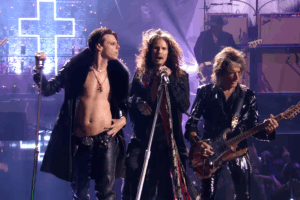
Gilmour vs. Waters: The Creative Clash That Shaped ‘Comfortably Numb’
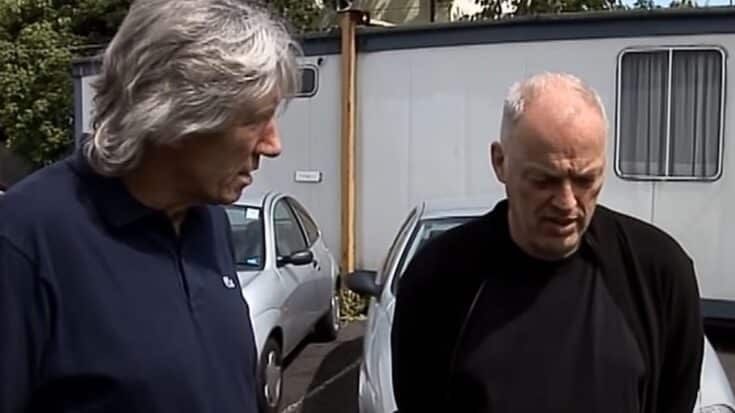
via floyd canvas miu / Youtube
Roger Waters was in agony on June 29, 1977, the night Pink Floyd were scheduled to play the Philadelphia Spectrum on their Animals tour. Crippled by stomach cramps, he faced a stark choice: cancel the show or take a tranquilizer shot so strong it “would have killed a fucking elephant.”
He chose the show. Numbed to the point where he could barely feel his hands or lift his arms, Waters performed through a haze of anaesthesia. That strange, drifting sensation would plant the seed for what would become “Comfortably Numb,” the emotional centerpiece of 1979’s sprawling concept album The Wall — and one of the last true moments of creative unity in a band already fracturing from within.
By this point, Waters was the dominant force in Pink Floyd, steering The Wall as a deeply personal exploration of loss, disconnection, and the suffocating pressure of fame. Although his hard-edged leadership would eventually push the group toward its first major split, the band was still—just barely—functioning as a collaborative unit during the making of the album. Nowhere was that uneasy balance more evident than on “Comfortably Numb,” which showcased the contrasting energies of Waters and guitarist David Gilmour with rare, perfect clarity.
Clashing Visions in the Studio
The song began as a Waters demo titled “The Doctor,” featuring awkward rhymes such as “listen,” “physician,” “condition,” and “magician.” When Gilmour suggested a chord progression left over from his first solo record, Waters resisted. Producer Bob Ezrin stepped in, urging Waters to open the track up, let it breathe, and collaborate.
Waters relented, contributing new lyrics and verse sections, while Gilmour shaped the now-iconic chorus progression.
Still, tensions mounted. Waters and Ezrin pushed for lush orchestration arranged by Michael Kamen; Gilmour wanted a more stripped-down rock sound.
“I fought for the introduction of the orchestra on that record,” Ezrin later said. “Dave saw it as a more bare-bones track. Roger sided with me.” “We argued over Comfortably Numb like mad,” Gilmour admitted. “Really had a big fight, went on for ages.”
The eventual solution was a hybrid. “On the record,” Waters told Absolute Radio, “the first verse is from the version [Gilmour] liked, and the second verse is from the version I liked. It was a negotiation and a compromise.”
If the arrangement was disputed, Gilmour’s soloing was not. The track’s emotional arc demanded something immense, and Gilmour delivered — twice. The first solo served as a prelude; the second emerged as one of rock’s most revered guitar passages.
“I banged out five or six solos,” he said. “Then I make a chart noting which bits are good. By following the chart, I create one great composite solo by whipping one fader up, then another, jumping from phrase to phrase until everything flows together.”
The result was a performance many consider the finest in Pink Floyd’s catalog. Waters’ harsh, clinical verses—sung as the doctor sedating an anguished Pink—collided beautifully with Gilmour’s dreamlike chorus vocals, heightening the song’s sense of dissociation and escape. Together, they created a moment of unearthly calm near the end of The Wall’s third side, just before the album lurches into its increasingly unstable final act.
The Song That Outlasted the Band
Onstage, “Comfortably Numb” became even more iconic. During The Wall’s elaborate live shows, Gilmour performed the climactic solo from the top of the massive brick wall built across the stage — a spectacle that stunned audiences long before such theatricality became common.
“It was fantastic,” Gilmour recalled. “I’m in pitch darkness and no one knows I’m there yet. Roger finishes his line, I start mine, the spots come on, and suddenly everyone’s heads lift up. Every night there’s this sort of [gasp] from 15,000 people.”
Yet even such transcendent moments couldn’t save the band. After The Wall, Pink Floyd released 1983’s bleak The Final Cut, essentially a Waters solo project with the band as supporting players. Waters left soon after, initiating a long, bitter battle over the band’s name and legacy.
“I think things like Comfortably Numb were the last embers of mine and Roger’s ability to work collaboratively together,” Gilmour later reflected.
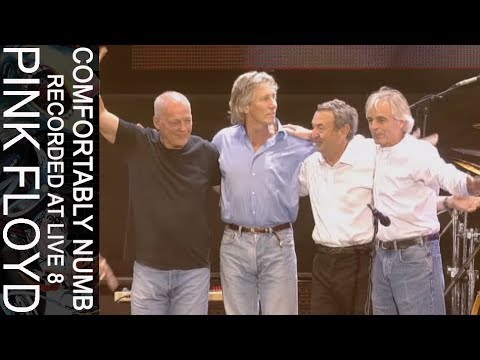
But the song didn’t vanish into the ashes of their feud. Instead, it became the unlikely bridge that brought them together—twice. It closed their emotional reunion set at Live 8 in 2005, and in 2011, Gilmour unexpectedly agreed to join Waters at London’s O2 Arena to perform it atop a reconstructed Wall.
Waters explained how it happened:
“Dave wanted to do this thing called the Hoping Foundation. Finally I said, ‘Tell you what — you come and do Comfortably Numb at one of my O2 shows, and I’ll do the bloody Hoping Foundation.’ I thought he’d just go, ‘Fuck off.’ And he didn’t. He went, ‘All right.’ So we did it.”
A Legacy That Only Grew Stronger
Though Waters and Gilmour never fully reconciled, “Comfortably Numb” continues to connect them in ways no conversation ever could. Decades after its creation, the song has become more than the product of a turbulent partnership — it has become a shared monument neither man can claim alone. In recent years, both artists have performed it separately, each bringing a different emotional weight: Waters with icy theatricality, Gilmour with soaring melancholy. The contrast only underscores the strange alchemy that made the original possible.
If Pink Floyd’s classic lineup never reunites again, “Comfortably Numb” remains the enduring evidence of what they could achieve together: a masterpiece forged not from harmony, but from friction, compromise, and the undeniable spark that once united them. It is, fittingly, the song that refuses to let their story fade quietly into the dark.